
Red Planet Day 2026
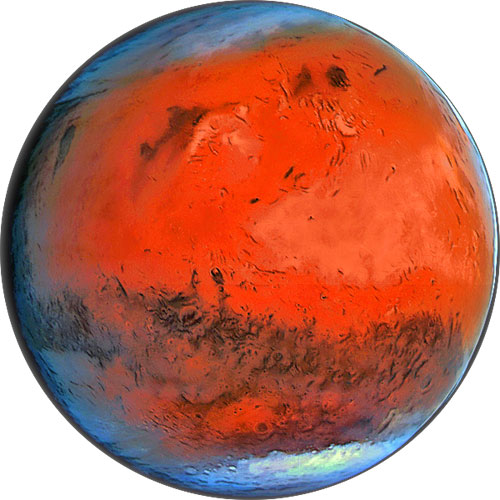 |
Mars is about half Earth's diameter with surface gravity at 38% of that of Earth. A Martian solar day ("sol") is about 24.6 hours, and a year lasts 687 Earth days (1.88 Earth years). Thin atmosphere mostly made of carbon dioxide, with temperatures swinging widely and water ice present at the poles and underground. Orbiting moons are Phobos and Deimos.
Notable martian features include Olympus Mons which is the largest known volcano in the solar system and Valles Marineris which is a massive canyon system.
Mars has been explored by orbiters, landers, and rovers—including NASA's Curiosity and Perseverance—with future robotic and human transport plans in development.
Today is Red Planet Day,
it is observed each November 28 in honor of Mars and commemoration of the launch of the Mariner 4 spacecraft. The Jet Propulsion Laboratory launched Mariner 4 on November 28, 1964. It became the first spacecraft to successfully fly past Mars and return close-up images of another planet.